 By
Paid UGC is a growth channel worth understanding, and this Lenny's Podcast episode shows what it looks like from the inside. Hector Serrano joined Wispr Flow at 19, made hundreds of the early ads himself, and now runs the paid UGC program behind its growth. He explains the model in numbers: 50 creators, 500 to 600 new ads a month, and top creators earning about $13,000 a month. The host cites 30x revenue growth in a year and a raise at around a $2 billion valuation.
The episode made me think about other tools, especially B2B. Handing a job to creators who are not your employees puts your product's reputation in their hands. How much risk that carries depends on your industry and on what a flopped piece of content costs you. The reported results are strong, and any team with room to run experiments should consider a small test. This article summarizes the model, then looks at what a B2B team should check first.
- 50creators in the capped roster
- 500 to 600new ads a month
- about $13,000monthly earnings of top creators
- 500 millionorganic UGC views in 2.5 months, at about $2 CPM
- 1,000 to 1,500applications a week, 1 to 3 accepted
- about $100,000ad spend at which an ad is effectively done (2 to 4 weeks)
Source: Hector Serrano on Lenny's Podcast. Figures are as stated by the speakers and have not been independently verified.
The product has to pull before paid UGC works
Paid UGC amplifies a product that people already want, which makes product pull the load-bearing assumption of the whole model. Hector Serrano says Wispr Flow grew because users liked it. He joined before launch, saw a few thousand early users, and about six months in the founder told him the team had found product-market fit. Every channel added afterwards fed a fire that was already burning.
Founders ask him for the hack. His answer is to look at positioning first: a product that does not grow on its own needs repositioning before it needs a bigger channel.
Once the pull exists, he recommends starting paid early. He learned from Wispr Flow's former head of growth to treat SaaS like e-commerce, where paid shows within weeks whether a message turns cold traffic into users. Organic content is harder to read, because most companies lack people who understand those channels well. A conversion signal from paid also suggests that the same message will work organically once it is tuned. On saturation, his view is that new angles, messages and ICPs keep a channel open.
Organic vs paid UGC: what 500 million views taught
Organic UGC pays creators per view to post on their own accounts. Paid UGC takes a creator's video and runs it as an ad, with pay tied to performance. Wispr Flow tried the first model before the second.
In early 2025 an intern named Tobin set up an organic group. Creators posted product videos on alternate accounts and earned roughly $2 per thousand views, tapering as views rose. The program produced about 500 million views in two and a half months at very low CPMs. Conversions lagged, because the views were vanity metrics and a dictation tool is harder to sell to students.
When Tobin left, the team saw that replacing him would be hard and ended the program. He later got stronger results at Polymarket by moving beyond top-of-funnel concepts, and Hector still rates organic UGC when it avoids vanity metrics.
The lesson Hector carried over is the structure. Paid ads were already working well, so he applied Tobin's playbook of a creator community, a roster and pay on performance to paid, with ads that pitch the product more directly.
How the creator payout model works
Wispr Flow pays creators a percentage of the ad spend their videos generate, with a retainer as a floor. The ads run through Tribe, a platform that began as an internal tool for a clothing brand that grew on TikTok Shop. Creators publish ads from their own handles and earn on performance. Hector describes it as the TikTok Shop method applied to Meta ads, and notes that SaaS companies cannot use TikTok Shop.
| Element | How it works |
|---|---|
| Commission base | Percent of ad spend for SaaS and freemium products, where attribution takes a week or two. Percent of GMV for e-commerce. |
| Smart retainer | A floor that tops up low commissions. Example: 25 videos for $1,500. With $500 in commissions the creator gets $1,000 extra. With $3,000 in commissions there is no top-up. |
| Payout cadence | Every 7 days. |
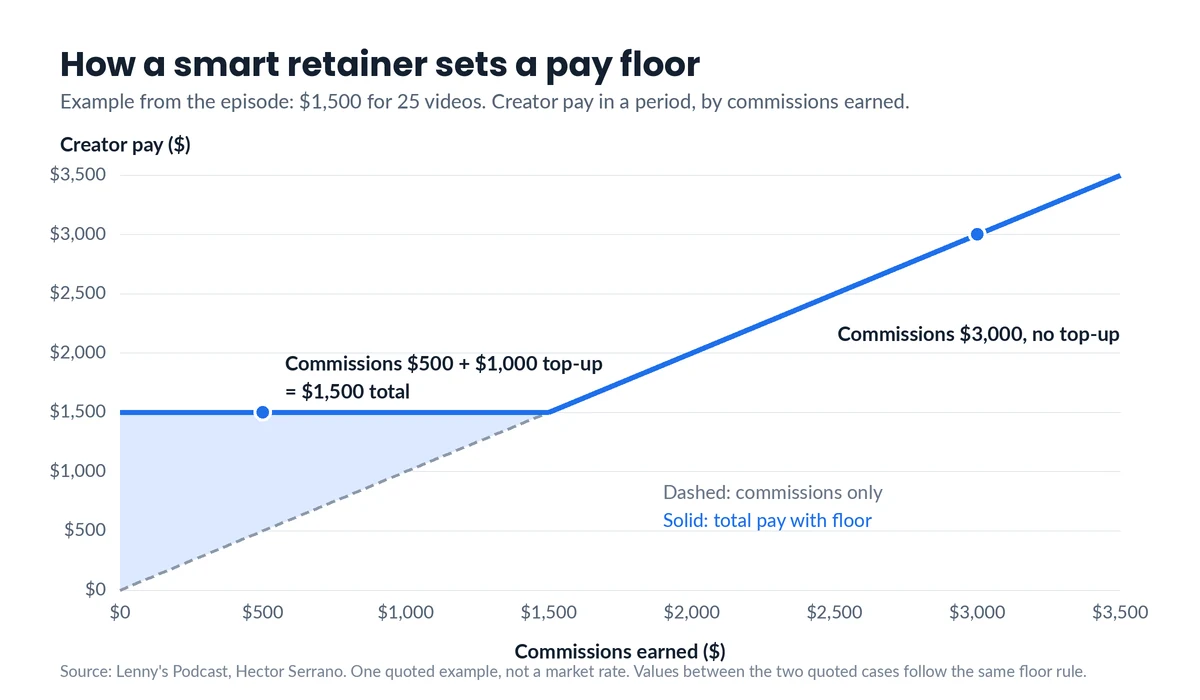
Percent of ad spend suits a freemium product because conversions take time to show, and creators should not wait weeks to learn what they earned. The retainer protects the early months. A creator who films 30 videos and earns $100 in commission loses motivation, so the floor keeps people around long enough to improve. Over time the best creators move to pure commission, which Hector calls the best case for the brand because it pays only for ads that perform.
Earnings are uncapped. Hector cites creators earning about $13,000 a month, some of them with only 1,000 to 2,000 followers. Weekly payouts add a steady stream of small wins that keeps new creators motivated.
How do you build a creator roster?
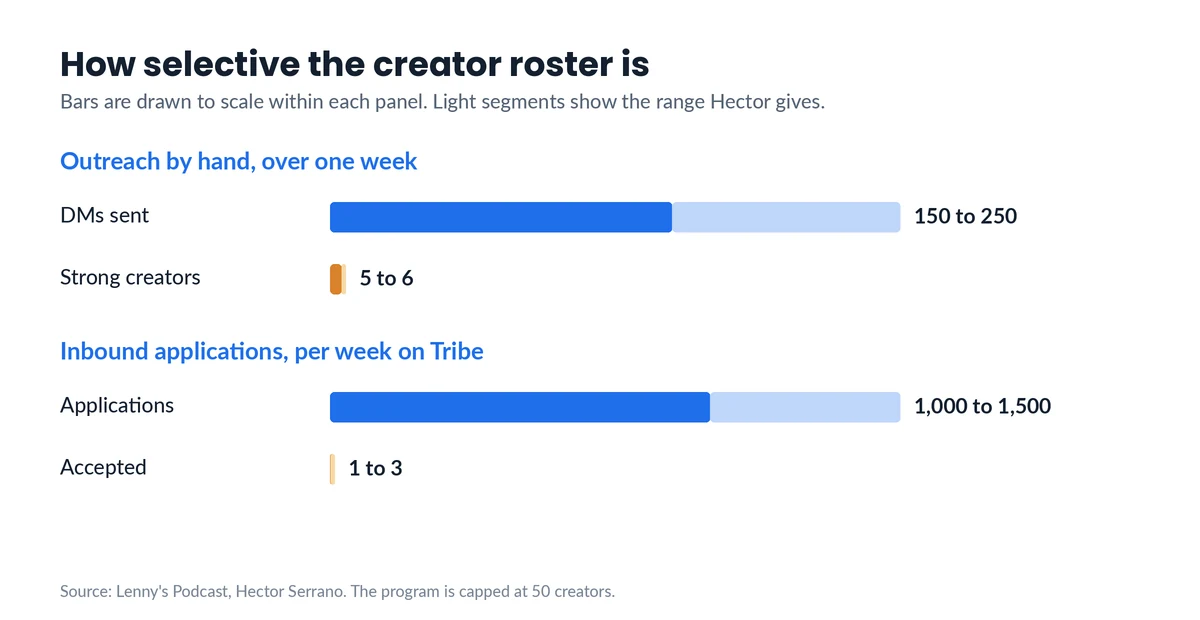
Hector built the roster slowly and by hand: 150 to 250 targeted DMs in a week produced 5 to 6 strong creators. A new brand shows $0 paid out on Tribe, which deters creators, so he searched Instagram by niche keywords and followed creators' follower lists, since good creators tend to know other good creators.
| Stage | What he did |
|---|---|
| Source off-platform | Instagram keyword search by niche, then follower lists. |
| Outreach by hand | 150 to 250 targeted DMs over a week yielded 5 to 6 strong creators. |
| Build culture | Weekly meetings, creator coaches, giveaways, a retreat in San Francisco. |
| Grow slowly | Roughly 5 to 10 to 15 to 20, adding 5 to 6 creators every few weeks. |
| Use inbound | 1,000 to 1,500 applications a week, 1 to 3 accepted. Tribe shows about $300,000 paid out. |
| Referrals | $100 per accepted referral. The group is capped at 50. |
His first DM does not mention the performance model, because creators are still skeptical of it. It says he likes their content and invites them into the group. A short PDF and a call follow, with slides on his own background as a creator, the media buyer, the product, how Tribe works and example ads. The goal is that the creator can start filming right after the call.
He chooses creators by gaps in the ad library. Five creators who each speak to a different audience produce more new concepts than 200 similar ones. The Wispr Flow roster includes moms, lawyers, engineers, sales reps, agency owners and an eight-figure e-commerce founder who makes ads for fun. Hector also treats creators as long-term partners, since word spreads fast among creators about brands that pay late.
Creative freedom and ad fatigue in paid UGC
Wispr Flow gives creators a product, a code and room to experiment, and it launches 500 to 600 new ads a month because ads wear out fast. Hector avoids long briefs, since a ten-page guideline strips out what creators do well. The one thing he coaches against is copying: creators see the top-spending ads in the group and tend to imitate them. He says Meta's Andromeda system groups near-duplicates by scanning the transcript, the frames and the on-screen text, so sameness shortens an ad's life.
The scale of turnover explains the volume in paid UGC. Ads that reach about $100,000 in spend are effectively done, and at current budgets that can take two to four weeks. Wispr Flow has around 5,000 lifetime ads with 800 to 900 live at a time. The library also holds statics, celebrity and influencer videos, in-house ads, launch videos and founder-led pieces.
One of the best ads showed a keyboard on a rainy roof with the raindrops typing. Hector says no brief would have produced it.
Does paid UGC work for B2B?
Hector says paid UGC works for any product with reachable individual users, and the episode supports that for product-led software. His route to enterprise is to win individual users with content, let them tell colleagues, then chase the company account. UGC means user-generated content, so a dev tool needs technical creators, and a $3,000 sleep product needs a creator the buyer trusts.
For technical or older audiences he finds that plain formats win. A 30 to 60 second screen recording of someone using the product has been among his best ads, and he calls some of them ugly. The host sums up the scope: the model fits product-led, bottom-up products like Wispr Flow or Notion, and fits Workday or Salesforce much less.
Three questions stay open:
- Buying cycle. Wispr Flow is a freemium tool that a user can try within minutes. Sales-led B2B products with long cycles offer no such path, so the commission math changes.
- Attribution. Hector pays on ad spend because conversions take one to two weeks to show. A product with multi-month cycles has a wider gap.
- Evidence. Every result comes from one company with a consumer-friendly product, and the episode has no second B2B case.
I have not run a creator program myself, so treat these open questions as my own reading of the episode.
How to protect your reputation
Hector's controls start with who gets in and who approves what runs. These are the ones he states:
- A capped roster of 50, with 1 to 3 creators accepted from 1,000 or more weekly applications.
- Creators who already use and like the product.
- His own approval of videos before they run, and a media buyer who owns the ad account.
- Prompt payment and a close-knit community.
- Human-made final creative. He says AI-generated ads look off, and that errors land on the brand.
My inference for B2B teams, not from the episode:
- Write a short claims sheet with the statements creators may make about security, compliance, pricing and performance, and review each video against it.
- Pick creators from the buyer's own profession.
- Check disclosure requirements for paid creator ads in each market.
- Name one reviewer. Reputation risk grows with ad volume, and the review step keeps it manageable.
Risk also follows the category. A wrong claim about a finance, health or security product costs more than a weak ad for a note-taking app.
Who should run a paid UGC program?
Hector's profile for the lead of a paid UGC program is a creator with a small proven following, hired for energy over credentials. His test has three parts: has the person grown an account to 10,000 to 15,000 followers, do they work hard, and are they a good person to have on the team? He rates Instagram as a stronger signal than TikTok. A job post with a $200,000 salary and large equity attracts the wrong people for this role, in his view.
His own path shows the pattern. He applied to about 200 creator jobs at 19, joined as an early hire, and spent roughly his first seven months unfocused before the team gave him room to find a lane. He argues for young talent because founders in their thirties and forties often miss what works on Instagram, TikTok and Discord, and he compares the approach to a football academy: scout early, coach, and allow failure.
The core team is lean. Hector handles creators, concepts and approvals, and a media buyer runs Meta, LinkedIn and YouTube. The marketing team is about 15 people inside a company of more than 120.
Founder-led content as the second lever
Hector treats founder-led content as a long-term companion to paid, with one mission running through every episode. Wispr Flow's mission is reaching one billion daily active users, and he likens the channel to a series where every episode serves the same plot. He advises giving value for a year before any soft sell.
He ties it to paid directly. A customer may need around seven touches before buying, so a strong organic presence makes paid conversions cheaper, and paid usually gets the credit. He ranks the YouTube packaging team highest, since titles, thumbnails and pacing decide whether a good video gets seen. The Wispr Flow channel had about 20,000 to 21,000 subscribers and millions of views after roughly three months and five videos.
A first paid UGC test for a B2B team
A sensible first test is small: ten creators, one quarter, one metric. This section is my own suggestion, built from what Hector describes.
- Pick the metric first. Qualified signups per creator. Views and clicks stay secondary.
- Choose creators from the buyer's world. The people who do the job your product supports.
- Review every video. A claims sheet and one named reviewer, as above.
- Pay on results with a floor. Percent of ad spend plus a small retainer if your product has a free path. Otherwise use a flat fee per video.
- Set the stop rule before you start. Decide how many videos a creator gets before you review their results.
The outcome depends on your buying cycle and your category. If you have run something similar, I would like to compare numbers.
The takeaway for B2B teams
Paid UGC rewards teams that already have product pull, a small roster they can review, and one clear metric. Wispr Flow shows the upside in a freemium product, and the open questions for B2B come down to buying cycle, attribution and claim review. My recommendation is a ten-creator test for one quarter, measured on qualified signups per creator. The question I want to answer next is how fast a B2B team can review creator videos without removing the freedom that makes the ads work.
Source: Lenny's Podcast with Hector Serrano. Figures are as stated by the speakers and have not been independently verified.
Frequently asked questions
What is paid UGC?
Paid UGC means a brand runs a creator's video as an ad and pays the creator, often on performance. At Wispr Flow, creators publish ads from their own handles and earn a percentage of the ad spend their videos generate.
How much do creators earn from paid UGC?
At Wispr Flow, pay is a percentage of ad spend plus a retainer floor, paid weekly. Hector Serrano cites top creators earning about $13,000 a month. His example floor is $1,500 for 25 videos. These are one company's figures and not a market rate.
What is the difference between paid and organic UGC?
Organic UGC pays creators per view to post on their own accounts. Paid UGC runs the creator's video as a brand ad, so pay follows ad performance. Wispr Flow's organic program reached about 500 million views in two and a half months, but conversions lagged.
Does paid UGC work for B2B?
Hector says it works for any product with reachable individual users, and the episode supports that for product-led software. Open questions remain for sales-led B2B: longer buying cycles, wider attribution gaps, and results from only one company.
How do you protect your brand when creators make your ads?
Hector keeps a capped roster of 50, accepts 1 to 3 creators from 1,000 or more weekly applications, and approves videos before they run. A B2B team can add a claims sheet and one named reviewer.